

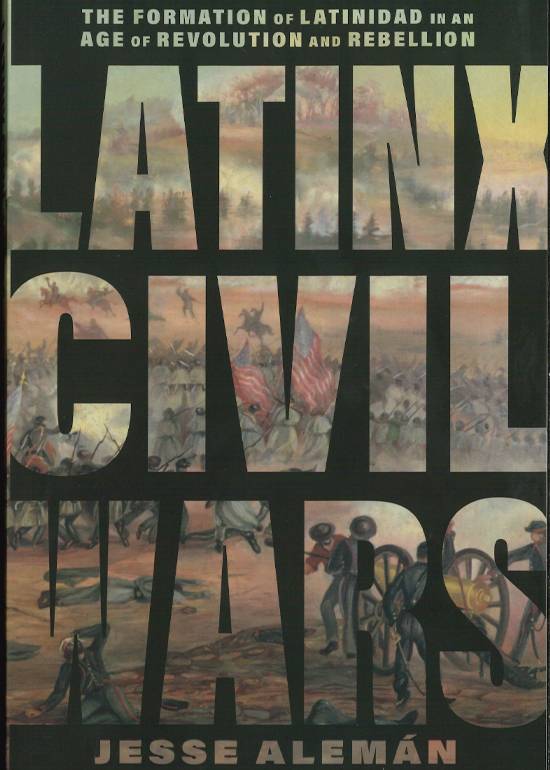
Latinx Civil Wars
by Jesse Aleman
New York: NYU Press, 2026.
264 pp. $30.00 Paperback.
Reviewed by
John Mckiernan-González
“I find this to be a book whose methods uncover the literary dimensions of what it means to try to become part of the United States when people split those American parts and then violently reunited.”
Elision. To skip past a letter. To avoid. To slide past. To delete. To ghost. In Latinx Civil Wars, Jesse Aleman works to make the Latinx presence in the civil wars in North America hard to elide, impossible to move past, to make these war writings and writers unavoidable, and difficult to ignore. This literary history’s refusal to allow forgetting is particularly important as we are still grappling with the remembrances and the legacies of the largest slave uprising in the Americas (DuBois, Black Reconstruction, 1935), otherwise known as the American Civil War. And Latinx Civil Wars has readers committed to understanding Latinidad as historically constructed identities address some uncomfortable elisions and hauntings, particularly around Confederate affiliations. I find this to be a book whose methods uncover the literary dimensions of what it means to try to become part of the United States when people split those American parts and then violently reunited.
The case studies in Latinx Civil Wars begin in post-1848 California and move east. This decision allows Aleman to feature people connected to discontent, insurrection, and organized violence to U.S. occupations, slave rebellions, Native American counterinsurgencies, sectional conflicts, and civil wars in Mexico, USA, and Cuba. The first case study begins with the de la Guerra brothers, born in Mexican California, tutored in Georgetown and New York and placed in the care of THE William Tecumseh Sherman. The brothers then volunteer for the United States Army and end up stationed in Northern California and Arizona and carry off epistolary relationships with family members and General Sherman. The focus shifts to two of New Mexico’s iconic officials in territorial New Mexico and Colorado, tracking their conflicts with and embraces of chattel slavery and the everyday presence and ongoing elision of the enslavement of native communities in nominally anti-slavery households. The status of peonage is then aired through the memoir of James Santiago Tafolla—born to peonage in New Mexico, runaway to Texas, overseer in Georgia, Tejano confederate, refugee to Mexico. Aleman then tracks the diplomatic career of Cuban poet José Agustín Quintero, who becomes the ambassador for the confederacy to northern Mexico and pushes the Confederacy as a model for Cuba and maybe the gulf coast of Mexico. The analysis then shifts to Cuban-born Ambrosio Gonzales, who does his utmost to become a member of the South Carolina secessionist elite, and yet never arrives. The final case ends with the Cavada brothers, both brought up in the worlds of American and Cuban culture in Pennsylvania, both of whom join the union effort—are decorated, brush up against Walt Whitman, paint, write, end up captured by the confederate army, are freed and then, after being appointed consuls in Cuba, join the anti-slavery wing of the war for Cuban independence. Fred Cavada becomes known as ‘General Candela’ [General ‘light it up’] adopting Sherman’s burning of plantations; Adolfo continues to organize and defend insurgencies in Cuba. The biographical case studies in Latinx Civil Wars clearly demonstrate that there is no obvious relationship between Latino identities and national affiliations during civil wars and national revolutions.
What makes the case studies unavoidable is the near-chronological examination of the ways the stresses of the wars change the self-presentations and accompanying understandings of the other, be they Diné or Apache insurgents, superior officers in the U.S. Army, workforces in cotton or sugar plantations or the white nationalists some sought to emulate. In the introduction, Aleman points to the easy ways some top U.S. based historians wave at Mexican involvement in the wars as easily anti-slavery, but elide using the original Spanish-language texts that explain their degrees of involvement in these many wars, that being based in Texas, New Mexico or California is not enough to explain attitudes toward enslavement or secession, and that only a careful examination of writing may indicate the way these writers understood their situation and maybe themselves. The literary-style analyses of personal correspondence, public statements, and public writing point to how ways of expressing themselves in Spanish or English are difficult to translate into the ways the Civil War is understood at these times.
The book could have ended there. However, Latinx Civil Wars also pushes readers to expand their canon of Civil War literatura past María Amparo Ruiz de Burton’s Who Would Have Thought It and Loreta Janeta Velasquez’s The Woman in Battle, a memoir of their journey taken disguised as a man through Confederate lines. Writing themselves as white, transitory subjects regularly claiming white racial identity, especially when other identifications had started to emerge. Aleman emphasizes out that these two writers’ pointed affiliation with white national identities over identifications with indigenous, Black, Creole, or Mexican formations during the Civil War cross-cuts all of these correspondences, that it—the possibility of a white racial identity—is part of the sojourns that these writers undertook during the war. Aleman points out that all confronted the possibility; Aleman also points out the challenges these writers faced embodying white American identities, that what seemed solid at one point, became highly contingent at others.
As a historian who seeks ways to connect Mexican American experiences to the main currents of American history, some of these chapters provide ideal stand-alone pieces for understanding aspects of the Civil War as they affected Tejano and Mexican communities west of the Nueces river. Together, they point a picture of Latinos and Latinas at cross-ways with the establishment of U.S. identities through the Civil War. Jesse Aleman has provided a difficult read, challenging the alluring idea that the end of military hostilities allowed what are now Latinx participants in the U.S. war effort to inhabit a comfortable American identity. Latinx Civil Wars brings people known mostly to scholars of nineteenth century California, New Mexico, South Carolina and Cuba and places them alongside a variety of iconic protagonists or scenarios in the American Civil War, making these writers and Latinx Civil Wars unavoidable to anyone seeking a general understanding of the Civil Wars in North America.
John Mckiernan-González is the Director of the Center for the Study of the Southwest, the Jerome and Catherine Supple Professor of Southwestern Studies, and an Associate Professor of History at Texas State University. His first book, Fevered Measures: Public Health and Race at the Texas-Mexico Border, 1848-1942 (Duke, 2012), treats the multi-ethnic making of a U.S. medical border in the Mexico-Texas borderlands. He co-edited the volume, Precarious Prescriptions: Contested Histories of Race and Health in North America (University of Minnesota, 2013) which examines the contradictions and complexities tying medical history and communities of color together. With Jessica Pliley, he co-edited Capturing Labor: a History of Unfree Work in the Southwest (University of Texas Press, 2026) which tracks the reproduction of unfree work after abolituin in the Southwest. His broad takes on Latina/os in U.S. medical history can be found in American Latinos in the Making of the United States and in Keywords in Latina/o Studies (NYU, 2017). His next project, Working Conditions: Medical Authority and Latino Civil Rights tracks the changing place of medicine in Latina/o/x struggles for equality. Born in the U.S., he grew up in Colombia, Mexico, and the U.S. South and brings a migrant eye and experience to his projects in public history, medical history, and Latino studies.