

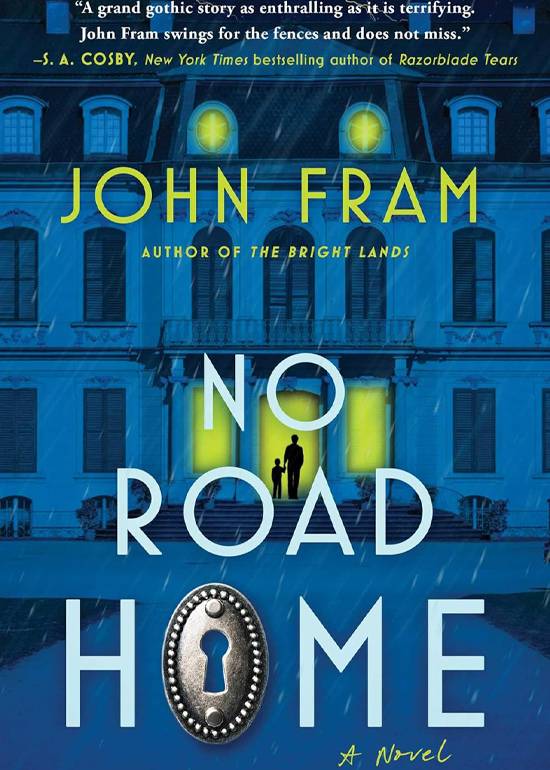
No Road Home: A Novel
by Jonathan Fram
New York: Atria Books, 2024.
396 pp. $29.99 Hardcover.
Reviewed by
Mary Mitchem
“In his second novel, No Road Home, Jonathan Fram explores the question: “What kind of prophet doesn’t see his own murder coming?” ”
In his second novel, No Road Home, Jonathan Fram explores the question: “What kind of prophet doesn’t see his own murder coming?” Jerome Jeremiah Wright, a revered televangelist and charismatic host of The Prophecy Hour, has built his ministry and fortune on the claim that he understands God’s will and sees what others cannot. Jerome’s prophecies grow increasingly dire as he warns that divine judgment is coming for his family, whom he calls “a brood of vipers” in need of repentance. When the Wright clan gathers at their sprawling Texas compound to celebrate granddaughter Alyssa’s birthday and her recent wedding, the prophecy’s first victim is the prophet himself. Jerome is found dead, and soon after, threatening messages appear on the walls in dripping red paint, warning that the time for mercy has passed: “God’s judgment on this family has begun.” Despite this provocative premise, the novel struggles to deliver on its potential due to an unwieldy cast of characters, increasingly disturbing family secrets, and deceptive narrative twists.
Tensions rise within the family as a storm of biblical proportions gathers outside. Floodwaters swell the creeks and cut off the roads to the Wrights’ estate and communication with the outside world. Alyssa’s husband, Toby, and his seven-year-old son, Luca, are trapped at the compound with the rest of the Wright family, a killer in their midst. Meanwhile, a dark figure moves through the mansion’s shadows, seen only by Luca. Toby must protect his son from the troubling visions of the man Luca calls Mr. Suit, and from the Wright family’s bigotry. Critical of Luca’s feminine appearance and mannerisms, they plan to send him to Camp Cleave, a remote wilderness camp where generations of boys have gone to be broken into obedience and “cured” of their so-called perversions. When Toby begins searching for the truth behind the prophet’s death and the wilderness camp, he discovers the Wright family’s alarming past. Each discovery stirs painful memories he struggles to keep buried in the recesses of his mind. As suspicion mounts and blame for the prophet’s murder begins to fall on Toby, he must uncover the dark lies this sinister family is hiding, both from him and from one another, while protecting Luca from the growing danger around them.
Unfortunately, Toby’s investigation into the deceptions and hypocrisy in the Wright family becomes overwhelming and detracts from the plot. The novel introduces numerous subplots, including the sinister wilderness camp, the threatening messages on the walls, the family’s legal and financial troubles, and the mysterious figure in the shadows. The time spent developing and resolving these threads pulls attention away from the central question of who killed Jerome Wright. As one of the characters admits, “this family is so black with sin you couldn’t find it in the dark.” However, many of the book’s disclosures about the Wright family, particularly the explicit scenes of incest and physical and sexual abuse, feel more disturbing than illuminating, and only add shock value rather than meaningful depth to the story. In contrast, the film Knives Out (which has a similar premise) skillfully manages a web of family secrets and unreliable narrators without losing focus on its central mystery.
The novel is further burdened by the large number of Wright family members, often forcing the reader to refer to the character index to keep track of who’s who. Many members of the family are as flat as paper dolls, and seem to exist only to be fed into the shredder of the story’s escalating catastrophe. Near the novel’s conclusion, Fram refers to two of these characters as the “most overlooked members of the family,” as if to excuse the fact that readers barely know them before they meet their fate.
When No Road Home finally reaches its conclusion, readers may feel justifiably betrayed by the manipulative narrative twist that reveals the truth behind the prophet’s death. The Wright family are hiding many secrets, but this revelation is not only implausible, but also frustrating after hundreds of pages spent navigating so many other characters, subplots, and detours in search of the answer.
While No Road Home begins as a compelling exploration of murder, religious hypocrisy, bigotry, and family betrayal, it ultimately collapses under the weight of its ambitions. The reader’s journey in No Road Home is a long one, and the destination is disappointing.
Mary Mitchem is an MFA candidate in creative writing at Texas State University.