

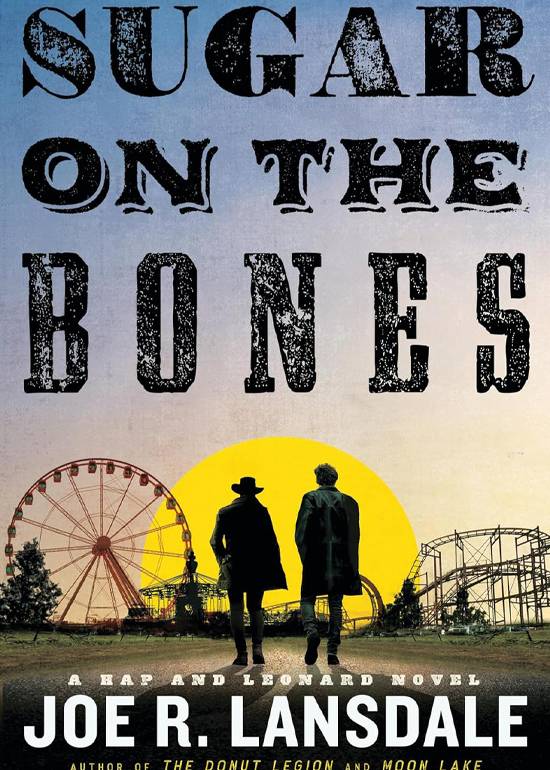
Sugar on The Bones: A Hap and Leonard Novel
by Joe R. Lansdale
Boston: Little, Brown and Company, 2024.
230 pp. $36.00 Hardcover.
Reviewed by
Charlotte J. Askew
“We could all use a little more laughter in our lives, and Sugar on the Bones delivers that in spades.”
You won’t be short of a reason to turn the page in the latest instalment in the Hap and Leonard series. Sugar on the Bones rips you along in short, snappy chapters and amusing wisecracks, a sensation akin to overhearing banter between old friends. This familiar, conversational tone zips at a rollicking pace for a fun read.
The day after declining the services of our Texas PI duo, Minne Polson turns up dead. Minnie’s daughter has also vanished, and Minnie’s eccentric and estranged husband has run off with a younger woman. Both family members stood to gain financially from Minnie’s death. However, as you might have guessed, there is something far more sinister in East Texas. The investigation into Minnie's murder uncovers a crime ring that transcends state borders and returns regular Hap and Leonard readers to a familiar cast of characters: Vanilla, Veil, Jim Bob, and Kung Fu Bobby. Between murder, insurance scams, and organ harvesting, the Hap and Leonard universe is one where the good guys might have to dodge a few bullets and kill a whack of people, but they always come out on top.
While the novel uses excessive metaphors and similes — “His face and shaved head were as sweaty as a whore’s ass on a Saturday night,”—some of the descriptions are so vivid the impressions linger long after the novel is finished — “An old refrigerator lay on its side near the carport as if recently executed.” Hap’s voice is equally rich as he narrates the novel, drawing the reader in from the outset with a pseudo prologue that begins, “I could start this true story right in the middle of the bad business, as there certainly was plenty of that, much worse than we could have expected.” This relaxed, intimate tone pervades the entire novel, capitalizing on personalized commentary and inside jokes to push the story forward. Hap and Leonard are easy to cheer for with their colorful personalities and endearing swagger.
Unfortunately, this careful characterization is diminished by the ease with which the secondary characters slip into cartoonish caricatures. Minnie’s husband, Al, has the emotionality of a brick, barely blinking when the news of Minnie’s death is delivered, despite claiming he never should have left her. He sheds a couple of tears and makes a show of vomiting upon assuming his daughter’s demise, but the display reads more as performance than genuine affection when he quickly recovers his outlandish personality for the remainder of the investigation. Between not noticing he’s missing pants the first time we meet him, allowing f mice to breed in his mobile home (and donating said mobile home to the mice when he purchases a yurt for himself), and the fact that he is inordinately wealthy, Al is too absurd to read as anything but a humorous gimmick. It was Al’s ridiculousness that ultimately revealed the villain’s identity to me, making for an unsatisfying puzzle.
The plot asks the reader to suspend disbelief on multiple occasions, suffering from stakes that escalate beyond plausibility. The villains are too far-fetched to adhere to realism, with purple eyes, otherworldly beauty, and evil reserved for severely disordered psychopathy. One could be forgiven for thinking them inhuman, which might work if people were one-dimensional and the novel were set in some other world.
Landsdale does, however, achieve what many authors of extended sagas cannot: a successful stand-alone. Supporting characters from the series are introduced with minimal nods to their connections, yet the context clues and plot are sufficient to guide the reader. And with reality slowly becoming more bizarre than fiction, I’m all too willing to forgive Lansdale’s flirtations with surrealism in the name of positive escapism. We could all use a little more laughter in our lives, and Sugar on the Bones delivers that in spades. With Hap and Leonard, you can experience what fiction does best: an adventure into your imagination, where the characters feel like your friends, and you are so busy chuckling you forget that you have laundry to do.
Charlotte Askew is an Australian writer, minimalist, and former counsellor. She holds a BSc First Class Honors in Psychology from the University of Southern Queensland and is the 2027 W. Morgan and Loue Claire Rose Fellow in the MFA Program at Texas State University. Charlotte’s short story “Somewhere Above the Artesian” was published in the 2025 Furphy Anthology.