

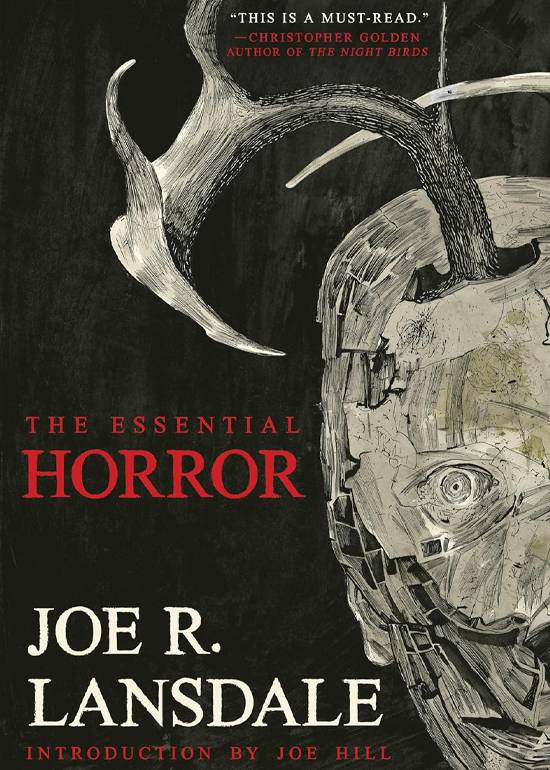
The Essential Horror of Joe R. Lansdale
by Joe R. Lansdale
San Francisco: Tachyon Publications, 2025.
336 pp. $18.95 Paperback.
Reviewed by
William Jensen
“Lansdale might better be compared to jazz musicians than his literary contemporaries, and this is why he remains the champion mojo storyteller of East Texas.”
In his introduction to The Essential Horror of Joe R. Lansdale, Joe Hill states it is too common to begin with comparison, placing one writer among others. With Lansdale, however, he writes, “We’ll have to bypass that kind of thing here. It ain’t gonna work.”
Hill is right.
Though there are obvious influences on Lansdale’s writings, he stands out as a maverick who has rewritten rules, traditions, tropes, and manners of fiction. He mixes humor and grit while blending genres, and he makes it look easy. Lansdale might better be compared to jazz musicians than his literary contemporaries, and this is why he remains the champion mojo storyteller of East Texas.
An anthology such as this typically has two audiences: fans who have already read every story but might want them collected in one volume; and newcomers who want an introduction. Most of these tales are famous and have been widely anthologized and adapted. Others, however, are more obscure, and show yet again how vast Lansdale’s range is. Some stories are violent, gory, shocking. Some are humorous, almost whimsical. All of them are distinct. All of them are solid. It is an excellent place to dive into Lansdale’s horror material if you’ve never encountered him before.
Lansdale’s two most famous pieces, “Bubba Ho-Tep” and “Night They Missed the Horror Show” are here, of course, as they should be. Both capture the yin-yang of Lansdale, his comical look at the world where anything can happen—such as a mummy who haunts a (possible) aging Elvis at a retirement home—and his unflinching condemnation of his region’s history of racism, misogyny, and bigotry.
“Night They Missed the Horror Show” won a Bram Stoker Award, and Lansdale considers it one of his best. It is a rough story about despicable, racist characters doing despicable, racist things—but the story is about racism, and the story’s power comes not from the ugliness or the violence but by the casualness of it all. The antagonists commit atrocities with as much thought as they would sip milk, cough, or tie their shoelaces. Lansdale terrifies you not with gore but with honesty. Even if you dislike the story—even if you hate it—you will not forget it.
On the other side of things, my two favorite stories in the anthology were much lighter in tone and content. They’re both super short, too. “Fish Night” is not so much horror as it is fantastical, but that doesn’t mean tension or fear are absent. I won’t give too much detail—almost anything is a spoiler with a story this short—but the dreamlike imagery is a stark contrast to the realism or terror elsewhere. My other personal favorite was more of a bawdy piece of flash fiction called “Love Doll: A Fable,” which explores sexism, misogyny, feminism, and gender roles in a modern-day fairy tale involving a blow-up sex doll. Again, I don’t want to ruin any surprises, but it is one of the few pieces of prose (ever) to make me snort-laugh as I read it.
One element of the anthology worth noting is that Lansdale gives each piece a mini-introduction. Some of these are tiny, just a paragraph. Others take up two columns on a page. Lansdale doesn’t try to analyze his work, but he gives background to the inspiration and sometimes the publication history, editorial advice, and revisions the story endured. Though brief, I found all of these fascinating. Like a director’s commentary for a film, Lansdale gives readers insights into his process and reveals a bit about how his history, upbringing, and his struggles have influenced him.
Ultimately, The Essential Horror of Joe R. Lansdale is akin to a greatest hits album. It is an excellent introduction to not only Lansdale’s fiction but to some of the best horror in the Lone Star State. It is a fascinating delve into the work that put Lansdale on the map and why his voice still resonates. Back in the 1980s, a lot of critics grouped Lansdale into the emerging scene of “splatterpunk,” a term Lansdale still despises. If anything, this collection serves as evidence that Lansdale is a completely different animal. You can’t shove Lansdale into any group. Joe Hill was right. It ain’t gonna work.
William Jensen is the author of Cities of Men, and he edited 2022’s Road Kill: Texas Horror by Texas Writers, vol.7. He is the editor of Southwestern American Literature and Texas Books in Review.