

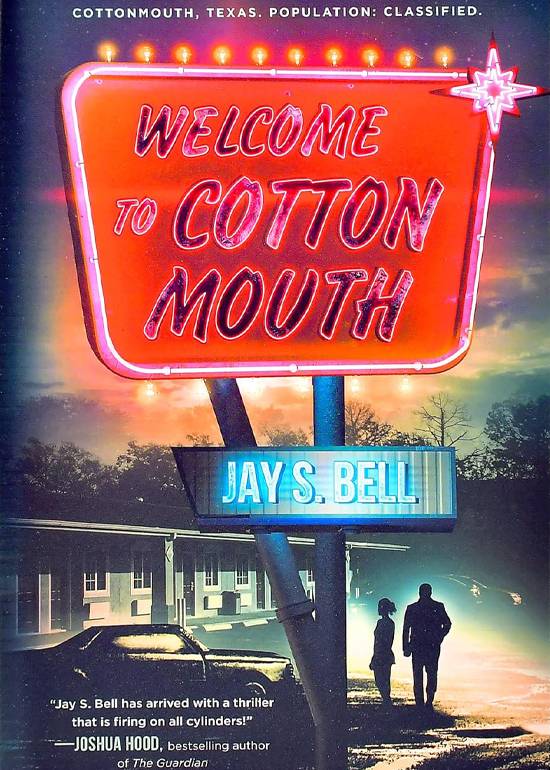
Welcome to Cottonmouth
by Jay S. Bell
Ashland, Oregon: Blackstone Publishing, 2025.
370 pp. $18.99 Paperback.
Reviewed by
Ruby Camacho
“Bell promises an action packed, guns-blazing, small-town war between hidden misfit government agents and a powerful international gangster.”
Jay S. Bell sets his debut thriller in Cottonmouth, Texas, a small God-forsaken town populated by average people with ordinary jobs: hotel manager, mechanic, café owner. Except these individuals are retired, specialized government agents: computer engineers, Russian snipers, Israeli undercover agents, Korean soldiers—all under the United States government’s eye. Cottonmouth is deliberately designed to draw attention away from itself. Bell entices readers with an intriguing premise, palatable enough to promise a fast-paced entertainment but instead delivers a stale, monotonous read.
Cottonmouth is desolate. The only visitors are stragglers and people who are lost—at least until Britte and Siobhan arrive. When their car breaks down, they are forced to check into a motel owned by the protagonist, Devlin Mahoney, a former US spy and Serbian-torture-prison survivor, who always dresses like a beach bum. Mahoney discerns there is something greater than what lies on the surface with the pair and because he cannot resist a help and rescue situation (especially for women) he responds heroically when danger comes looking for Britte and Siobhan. The women are fleeing Milos Stankovic, a powerful man who has control over prostitution and diamond smuggling regimes. The novel, therefore, centers on Mahoney protecting these women without exposing the truth about Cottonmouth.
Bell promises an action packed, guns-blazing, small-town war between hidden misfit government agents and a powerful international gangster. As a protagonist, Devlin Mahoney is a flawed, charming leader, who is troubled by his past and relies on dark humor to cope with the violence around him; he refuses to take anything, or anyone in authority, seriously. However, it appears Bell has committed most of his efforts in Mahoney’s character that the work reeks of authorial narcissism that it interrupts a page turning read. Mahoney is never truly wrong and never genuinely confronted with his shortcomings thus making him thin, familiar, and overly romanticized. The other characters, in their flatness, support Mahoney and shine in the trivial moments he is challenged, questioned, or threatened. Even characters who are diverse and nationally colorful—Korean, Israeli, Russian—speak in a similar voice and offer no depth or roundness.
The novel raises little stakes, a kidnapping here, a gun wound there, a trivial death there, but none attractive enough to encourage turning the pages since no one poses a real threat to Mahoney and his group of retired government agents. While I knew everything would work out in the end—Mahoney survives, deepens a romantic relationship with Britte, keeps Cottonmouth a secret from the public—I still wanted to feel more of the anxiety that things might not work out. Bell granted his imagination too much power where the novel develops as idealized projection of his own fascinations. In other words, Bell is too much of a God in this novel and does not allow characters to authentically live in the world he created. Instead, everything about this novel is overly constructed; the snappy dialogue, action scenes, and moments of distress are obviously manipulated. The biggest hinderance here is not the villain, but Bell’s unwillingness to allow his characters to genuinely exist on the page and let Mahoney realistically reckon with himself and the violence around him.
Welcome to Cottonmouth is not a serious, provocative thriller. It is best approached as a low demanding read. But despite my criticisms, I believe Cottonmouth is a town worth building a sequel. Perhaps a second visit will grant Bell a thriller where the characters are more exciting than their nationality and the protagonist has something to gain as well as something to lose.
Ruby Camacho is an MFA candidate in creative writing at Texas State University.