

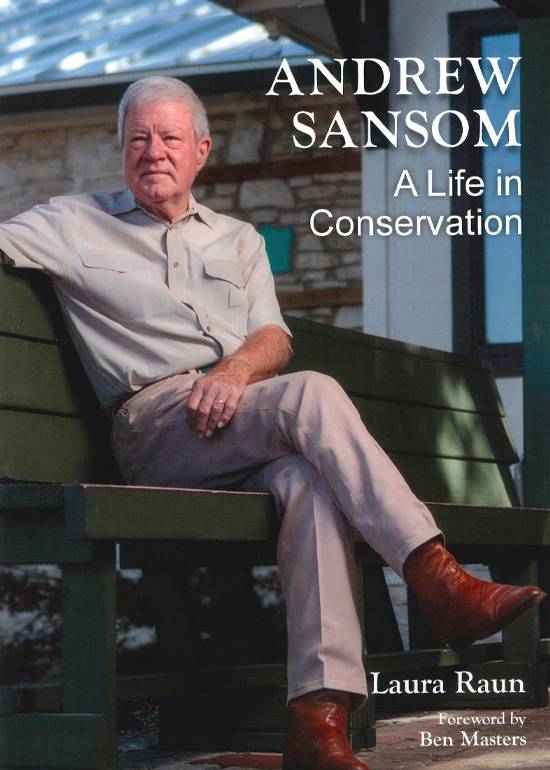
Andrew Sansom: A Life in Conservation
by Laura Raum
College Station: Texas A & M University Press, 2024.
268 pp. $34.95 Hardcover.
Reviewed by
William Huggins
“This book is a must-have for anyone interested in the history of the environmental movement.”
In Andrew Sansom: A Life in Conservation, readers get a glimpse into a one-of-a-kind Texas conservationist. The biography covers the major aspects of Sansom’s life, from birth in Nevada and formative years after a move to Lake Jackson, Texas, and onto college and his professional life as the executive director of the Texas Parks and Wildlife Department. Sansom lived through an array of societal changes, from the upheavals of the 1960s to the present day. The book is a compelling look at the life of an important and effective Texan public lands advocate.
This book is a must-have for anyone interested in the history of the environmental movement. Texas stands apart from many states west of the Mississippi in its amount of and attitude towards public lands, an issue that fuels political fires across the American West. Raum gives an excellent history and summary of why Texas’s public lands situation became so different from other Western states. This crucible created a cultural and political situation that made Sansom’s conservation work especially challenging.
As Raum’s research and writing shows, in many ways Sansom was ahead of his time.
The environmental revolution of the 1960s was not entirely embraced by the emerging fossil fuel hegemony and production driving much of the Texas economy, then as now, a bust or boom cycle that creates economic and environmental shockwaves that resonate beyond the present. Sansom knew his home turf. His patience, creativity, and understanding of Texas culture helped him win protections for many areas across the state, including but not limited to: Big Thicket National Preserve, Matagorda Island National Wildlife Refuge, Big Bend Ranch, Angelina-Neches, Elephant Mountain, and Chinati Mountains SNA. The history of the Bracken Cave bats and the importance of the Clymer Preserve stand out as stellar moments of Sansom’s ability to be patient and negotiate.
Raum doesn’t shy away from Sansom’s failures, either. As in any endeavor, failure will come along with success, in the personal realm as well as the professional. Impressively, Sansom is open and candid about his passion and drive and its impact on his personal relationships. Over the decades, Sansom had to walk away from many projects for various reasons. Even some solid projects had to be abandoned or were shelved by government fiat.
Sansom’s termination of the National Heritage Program drew specific criticism. The book highlights other land protection opportunities that failed, spanning the decades.
The book is replete with maps and graphs that help the reader understand the massive impact Sansom has had in protecting Texas’s wild lands. While words will always retain their power in good writing, numbers correlated over decades of persistence at the end of a book carry their own weight. Seeing the impact of Sanson’s efforts, parcel by parcel, shows the effectiveness of his methodology. The frontispiece of areas protected by Sansom speaks volumes on its own.
For those interested in the lifestyles of the rich and famous, Sansom’s life intersects with a multiplicity of Texas elites. Sansom encountered and befriended many powerful and famous Texans, many from the upper tiers of society. After a life-threatening accident, Nolan Ryan showed up at Sansom’s hospital bedside. Sansom managed to charm other Texas legends, such as Bob Bullock, into semi-submissiveness on public lands issues. Many names appear and reappear in the unwinding of Sansom’s life, including powerful political families including the Bush and Cheney families.
Readers learn that Sansom’s conservationist passions carried into his personal life, too. His interest in nature came from his childhood exposure to the outdoors, and later he attempted building a sustainable home. Raum details how Sansom’s lifelong work with multiple organizations, mostly nonprofits, helped expand children’s opportunities to get outside, hoping to build future generations’ environmental awareness. As a teacher, his passion motivated many students to take what they learned beyond the classroom.
Throughout his life, Sansom worked toward the greater good. Over his career, he “protected more than half-a-million acres of land in more than one hundred parks, wildlife management areas, and other protected lands the same way that [Teddy] Roosevelt protected” lands at the federal level. Importantly, he achieved this in a state whose politics continue to drift further and further away from the conservation ethic.
While this lifetime dedicated to the protection of open space stands as an impressive achievement, Sansom was ultimately “disheartened” by Texas’s lack of action on the climate crisis. Recent weather events in Texas and elsewhere show that we are poorly prepared for the warming that is coming and the impacts that warming will cause. Sansom’s life and work proves he is a true conservative of consensus. In this jarring political moment, if we seek some hope for the challenges that face our collective future, Sansom and his example may well stand as the type of person we need to create a more hopeful destiny for humanity and all the wild beings with whom we share this world.
William Huggins lives, writes, and works in Nevada. He is currently working on his third novel.