


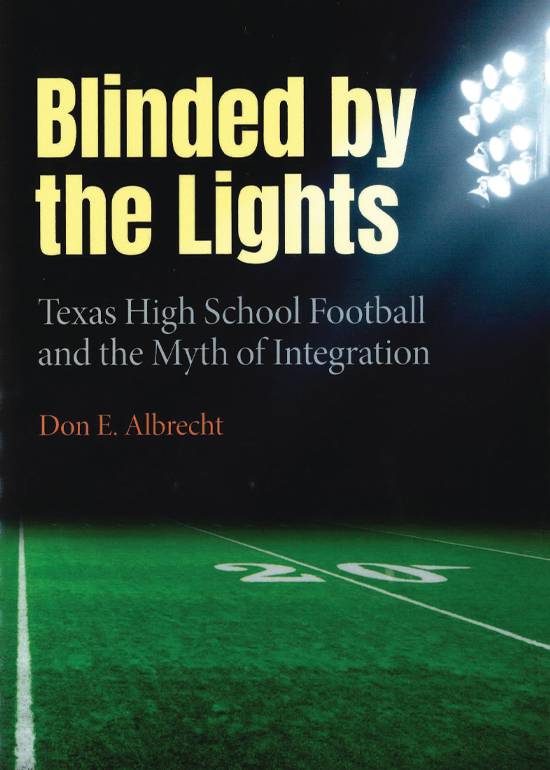
Blinded by the Lights:
Texas High School Football and the Myth of Integration
by Don E. Albrecht
College Station, TX: Texas A&M University Press, 2025.
184 pp. $32.50 Hardcover.
Reviewed by
Jorge Iber
“Albrecht makes important points and provides critical analysis of a disturbing trend in Texas high school football. For this, he is to be commended.”
Don E. Albrecht indicates at the start of this work that he spent almost thirty years working on this manuscript. It was time well spent. In a thin volume (150 pages plus notes) Albrecht covers the history of segregation, desegregation, and then the re-segregation of high school football in Texas. While he provides coverage of many sections of the state, he focuses on the communities of Houston, Dallas, Beaumont, Odessa, and Brownwood. Early on he presents readers with a key theme of the work, which is that “the competitive and cooperative aspects of sports can force participants and observers to accept each other as equals.” My own research provides ample support for this assertion. However, the principal thrust of this book is to ask the question of what happens after integration has been achieved and then a process of re-segregation takes place?
Over the first six chapters of the work, the author covers the story of the game’s arrival in the state, and documents early examples of how African American athletes were systematically excluded from schools, teams, and even the pages of local newspapers throughout Texas. These athletes and squads did not receive their proper due, and many believed that they could not play football at the same level as white competitors. Even after the issuance of Brown v. Board of Education (both decisions), it was a rarity to see integrated teams. Albrecht notes the story of the 1954 Friona Chieftains, the first integrated team in the state, and discusses the significance of the first contest featuring two integrated teams (between Robstown Cotton Pickers versus the Refugio Bobcats) in the fall of 1955. Still, by the mid-1960s, only three percent of African Americans were attending school with whites, and forfeits and desegregation disputes continued in many parts of Texas.
The book’s key sections are the chapters detailing the flatlining of integration and then the process of re-segregation. Albrecht correctly argues that this latter development occurred for two principal reasons: white flight (primarily to more affluent and monochromatic neighborhoods) and the opportunity for working and middle-class African Americans (including individuals such as teachers, small business owners, and others) to move into neighborhoods that they had not been allowed to live in previously. As Albrecht notes, the “abstract ideal of having an integrated school system for everyone has taken a back seat to assuring quality education for one’s own children.” Because of this trend, “individuals who held the minority community together and served as role models for neighborhood children have departed for suburbs that are wealthier, safer, and have better schools.”
The result of these trends has been a decline in the success of schools such as the Houston Yates Lions and the Dallas Carter Cowboys. Here were two teams (Yates in 1985 and Carter in 1988) that many football afficionados considered to be among the best, if not the best, teams in Texas high school football history. Many of these players went on to play collegiately, and some even made it to the NFL. During the late 1980s, it was common to see stands full of alumni at Carter games yelling out “Carter, baby!” whenever one of their young men made a significant play. Just as in other parts of the state, football was a source of pride for a community that had often been overlooked socially and economically.
Now, many of the athletes who have played for the Lions and the Cowboys in past decades no longer do so. Instead, many of these competitors now attend and compete for schools such as the South Lake Carroll Dragons and the Allen Eagles. In other words, these schools tend to have small African American student populations, but many of these students tend to play on the football teams. Since these schools are more successful, and thus gain greater attention from college recruiters, “students with potential, but attending low-income schools are generally unnoticed and ignored, and their potential is generally never developed.”
Overall, Albrecht makes important points and provides critical analysis of a disturbing trend in Texas high school football. For this, he is to be commended. Still, this reviewer has a concern that is theoretical in nature. Throughout the work, Albrecht argues for agency on behalf of individual athletes and communities. What these players and their parents wanted was an opportunity to play, get a good education, and gain the opportunities derived therefrom. It seems as if Albrecht does not condone the decisions that such individuals have made, that is, to leave their previous communities. What are these folks supposed to do? Stay in areas where they can serve as this author’s role models or move to a place they can afford, and which will provide better opportunities for their offspring. If the author is concerned with the notion of agency throughout this work, the question has a logical answer. If faced with this issue, what decision would Albrecht have made for himself and his children?
Jorge Iber is a professor of history at Texas Tech University. His research focuses on the role of Latino/as in sports in the United States.