

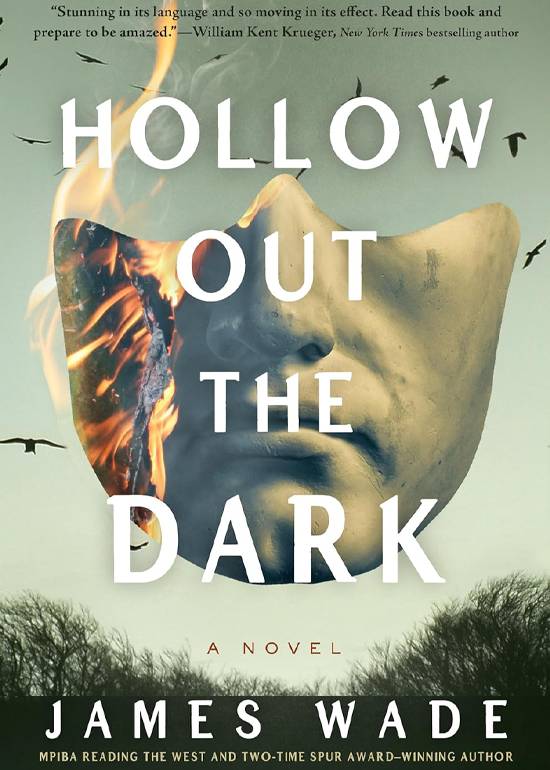
Hollow Out The Dark
by James Wade
New York: Blackstone Publishing, 2024.
328 pp. $25.20 hardcover.
Reviewed by
Jim Sanderson
“In this cold, in this dark, in this county, the characters try to hollow out some light in the dark. Few succeed.”
In Hollow Out the Dark, James Wade depicts a war between bootleggers in depression-era Texas. As the body count, double crosses, and complexities arise, one is reminded of Dashiell’s Hammet’s masterpiece, Red Harvest. Wade, however, offers a distinct narrator in contrast to Hammet’s tough, terse Continental OP. Wade’s voice is a character all its own and one to be celebrated.
The novel begins when Jesse Cole returns from war to find his brother has committed suicide and left his widow and children to fend for themselves. Jesse takes on his brother’s family as well as the duty of looking out for his friend Hollis who is in debt to the criminal brothers Squirrel and Frog, and it isn’t long before Jesse’s life and freedom are on the line.
One of the best things about Hollow Out the Dark is that Wade doesn’t just stick with Jesse but gives readers time with every character. The characters’ actions and dialogue reveal themselves, and Wade’s narration comments on the whole milieu of this East Texas county. Passages ponder time, history, culture, and the socioeconomics of the place making it another character all its own. In the early chapters, the narrator uses words, sentences, and phrases that approximate the stiff articulation of the ponderings or fears of the more sophisticated characters: “Jesse sat the porch after Sarah was abed and looked out at the knobbed and leafless oaks that stood heavy among thick tracts of lank, yellow pines. Dark and cold and quiet.”
In this cold, in this dark, in this county, the characters try to hollow out some light in the dark. Few succeed. With this narrative/literary style, Wade spends most of the novel establishing these characters and their convoluted, ruptured interdependences. But toward the end, the plot picks up speed and wraps the story up in a tragic way that manages both to satisfy and surprise.
Wade allows his narrator to follow or concede to certain contemporary literary habits. So many times, crime or mystery or action novels open with a first chapter that introduces us to one or more characters only to kill them off at the end of the chapter. Sometimes, these plot-crutch killings come later in the novel. And to help the plot, Wade’s narrator plays coy by not finishing the end of a particular shootout so that we are led to believe one outcome when another, unexplained one, comes to be true. And in another instance, the narrator doesn’t name the betrayer. We learn what happens and who happens later, but again I feel manipulated. And sometimes, similar to film, one character will enter a scene to interact with other characters. But at the end of the scene, the character we follow into the scene leaves, thus leaving us with the other lesser characters watching the character we followed in go away.
Wade deserves more readers and praise. For he takes classic noir with their plots and hard-luck heroes and stretches that darkness into a universal condition (especially in East Texas). The only way out is a hard-earned self-awareness that his characters use to hollow out that dark.
Jim Sanderson has published eight novels, and Brash Books has republished three and then combined all three in a digital edition. Additionally, he has published three short story collections, an essay collection, two textbooks, an “as told to” memoir, and about eighty articles, stories, or essays. For a living he teaches and served as chair for the English and Modern Languages Department at Lamar University. Lamar University recently appointed him as Writer-in-Residence.