

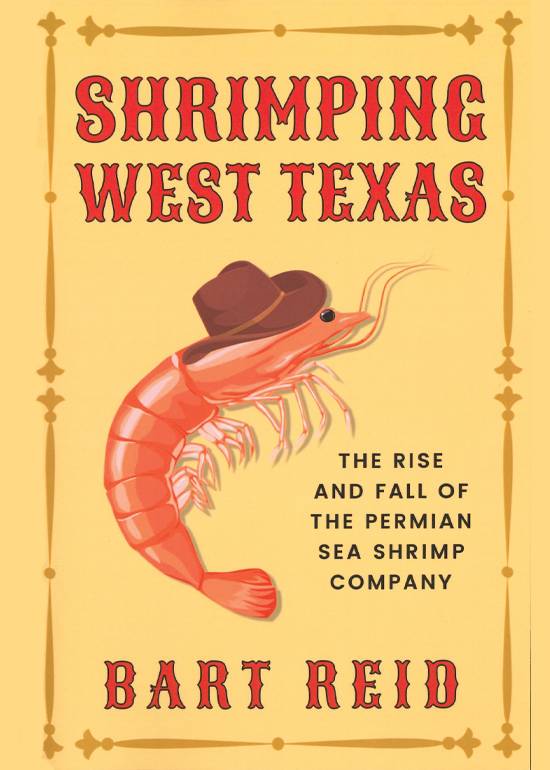
Shrimping West Texas:
The Rise and Fall of the Permian Sea Shrimp Company
by Bart Reid
Lubbock: Texas Tech University Press, 2024.
256 pp. $26.95 Paperback.
Revied by
Jahue Anderson
“Shrimping West Texas is a distinctive contribution to literature on aquaculture, environmental entrepreneurship, and rural innovation.”
Bart Reid’s Shrimping West Texas is a chronicle of an audacious and improbable aquaculture venture set deep in the heart of the West Texas desert. Marine biologist, entrepreneur, and co-founder of the Permian Sea Shrimp Company, Reid recounts the story of his company with a voice that blends technical authority, entrepreneurial optimism, and a wry appreciation for the absurd. What results is a lively account of how briny ambition collided with desert soil, and how a project many deemed outlandish ultimately left a lasting, if unconventional, legacy.
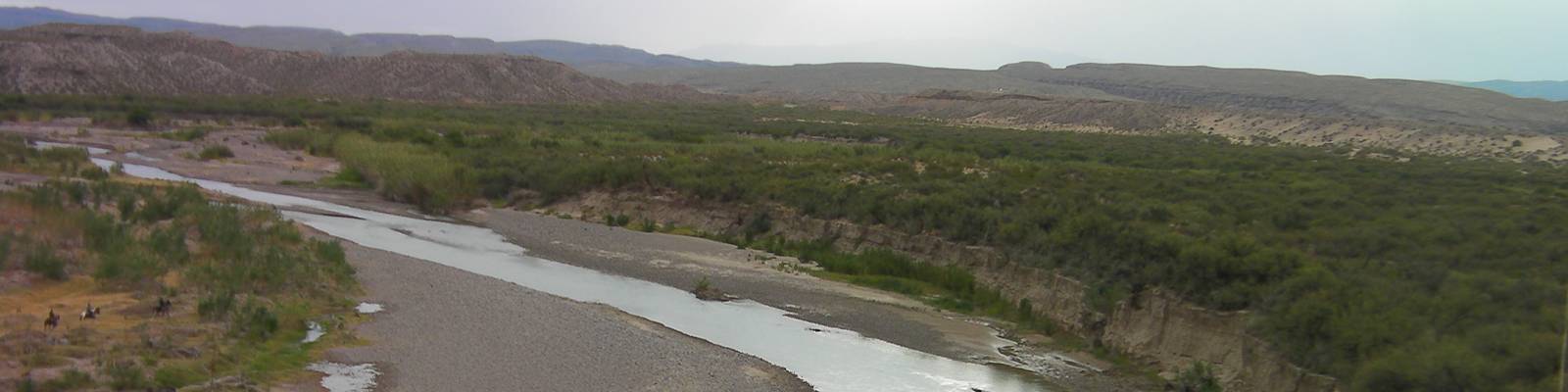
Spanning more than two decades of effort, the book details what Reid describes as “the harebrained notion” of raising shrimp in the Permian Basin. This is not the Gulf Coast or any other traditional shrimping ground. Instead, the venture relied on underground saltwater aquifers left behind by a Permian Sea. Through a mix of careful planning, blind optimism, and dogged experimentation, Reid and his team worked to turn a geologic oddity into a thriving aquaculture operation.
Reid documents the environmental distinctiveness of the region and the scientific challenges of cultivating marine life in an arid zone, but he also gives significant attention to the cast of characters that animated the venture. Businesspeople, scientists, investors, and local eccentrics populate the pages, their roles alternating between comic relief and genuine innovation. The tone is often conversational, and readers are treated to anecdotes that ground the science in place and personality—harvest scenes described as “hot, sweaty, and loud,” community funerals, and dusty diner deals all contribute to the narrative texture.
What sets the book apart is its fusion of technical detail and storytelling. Reid presents a clear and accessible account of shrimp aquaculture, explaining pond construction, water management, and harvesting practices in a way that is digestible even for readers without a background in biology. Yet he also connects these specifics to a broader context: how environmental constraints, entrepreneurial risk-taking, and rural identity intersected in a project few thought could succeed.
Reid’s qualifications add credibility to the work. With degrees in marine biology from Texas A&M and decades of experience in aquaculture, his observations are grounded in scientific rigor. His previous work in hatchery development and innovations in algae farming make him a well-positioned narrator for this tale. The book also serves as a subtle commentary on regional development and the kind of high-risk, high-reward thinking often associated with Texas entrepreneurialism. There is an unmistakable affection for the place, and for the people who said, “why not?” when others said, “you can’t.”
Still, the book is not without its limitations. While Reid generally balances technical exposition with engaging narrative, there are moments when the text becomes mired in detail. Lengthy discussions of water salinity ratios, drainage systems, or engineering missteps may test the patience of readers more interested in the broader story than the mechanics. Furthermore, the book is written from the inside, and while Reid is commendably candid about missteps and failures, the absence of external perspectives leaves the narrative somewhat one-sided. In a few instances, the tone veers toward justification rather than dispassionate reflection, though this is perhaps inevitable in a memoir of such a personal and ambitious endeavor.
Nonetheless, Shrimping West Texas offers considerable value for a wide audience. For scholars and readers interested in environmental history, aquaculture, or regional economic experiments, the book presents a case study that is both regionally specific and globally relevant. It demonstrates how unconventional environments can become laboratories for innovation, though not without cost. Those drawn to tales of unlikely ventures will find this book especially compelling. Readers from Texas, particularly West Texas, will likely recognize the people, places, and sensibilities Reid captures, while others will find in them a cultural portrait that is both humorous and deeply human. The inclusion of shrimp recipes at the end, a nod to Reid’s family-run shrimp store, adds an unexpected but charming personal touch.
Shrimping West Texas is a distinctive contribution to literature on aquaculture, environmental entrepreneurship, and rural innovation. It combines memoir, scientific explanation, business history, and cultural reflection into a cohesive and engaging narrative. Reid’s central message—that even the most improbable ideas can sometimes thrive, if only temporarily, in the unlikeliest of places—is as timely as it is Texan.
Jahue Anderson earned his PhD in history from Texas Christian University in 2009. He is an instructor of history at Tarleton State University.