


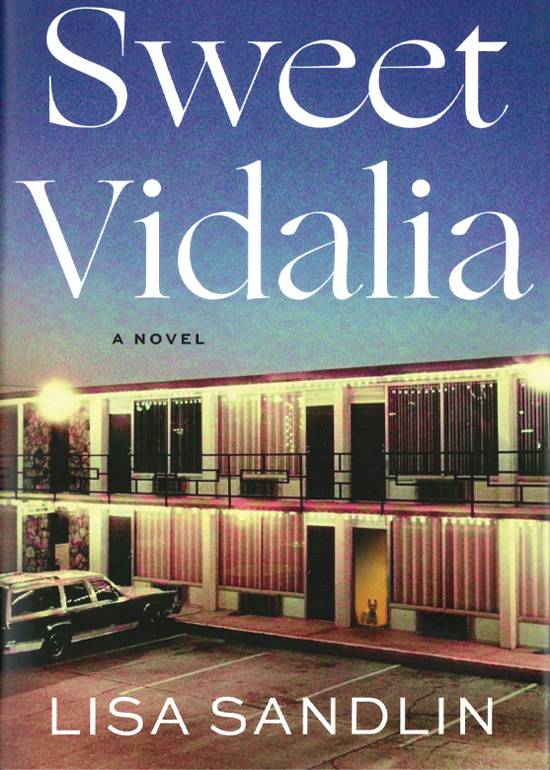
Sweet Vidalia
by Lisa Sandlin
New York: Little, Brown and Co., 2024.
309 pp. $28.00 Hardcover.
Reviewed by
Cheyanne Clagett
“Sweet Vidalia is worth reading as a study in grief and resilience because of how beautifully Sandlin captures Eliza’s vertigo as she teeters between the life she built with her late husband and the new reality she cannot avoid.”
Set in 1964 Texas, Lisa Sandlin’s new novel Sweet Vidalia follows Eliza Kratke as she endures her husband Robert’s accidental death and the revelation of his long-time affair and crushing financial debt. Determined to reset her life, Eliza moves into a local hotel called the Sweet Vidalia and enrolls in accounting classes at a nearby community college. Soon Eliza is surrounded by eclectic neighbors and struggles accepting her new life as a recently widowed woman in her late fifties. Although the novel’s depiction of minor female characters perpetuates stereotypes of hysterical women, Sandlin’s luscious characterization of Eliza in her sorrow, anger, and uncertainty drives the novel.
Sweet Vidalia is worth reading as a study in grief and resilience because of how beautifully Sandlin captures Eliza’s vertigo as she teeters between the life she built with her late husband and the new reality she cannot avoid. This tension is created in the first chapter when Eliza reflects on Robert’s secretiveness and thinks, “What could you have to say that I couldn’t stand?” This question of Eliza’s endurance is the novel’s core, around which everything else orbits. For example, as Eliza waits to learn whether Robert has succumbed to the injuries he sustained in a workplace accident, the narrator says, “The cold, still air…told her she had not escaped, was not currently escaping, that this was occurring now, this moment, that she was standing on a street in a moment that was not ending but being, going on and on without seam or relief.” The sentence’s hobbled rhythm reflects Eliza’s paralysis and forces readers to sit with the mounting anxiety she cannot resolve. Eliza’s well-being and sanity become the reader’s priority, and it is rewarding to see her gain confidence as the novel progresses. Considering Eliza’s slow reinvention of self in the months since Robert’s death, the narrator explains, “It was whatever shards of pride Eliza gleaned amid the breakage that held her together. The vision that she could make a way for herself rather than have to take leavings.” Eliza frames this realization to herself as pride, but readers can recognize it as hope too, a fragile, desperate hope that all her effort will eventually be worth it. If nothing else, Sandlin succeeds at drawing readers into this gorgeously rendered character study of the grief-stricken protagonist as she remakes her life.
Despite Eliza’s rich characterization, two of the novel’s most promising side characters are flat, stereotypically hysterical women. The narrator describes Eliza’s adult daughter Ellen as “hover[ing], asking a flurry of questions” before Robert’s funeral and later “aim[ing] a flurry of batting at Eliza’s hand, little slaps that were physically painless.” Ellen’s actions are frenetic, lacking reason, direction, or power. When Ellen sees Eliza’s room in the Sweet Vidalia months after the funeral, the narrator notes that she “flipped over onto her stomach and was now sobbing into the pillow,” as if throwing a tantrum. Ellen never develops beyond these childlike, impotent expressions, and the novel does not consider how Eliza might relate to her differently after Robert’s death, whether she would try to pass on hard-earned wisdom or consciously preserve Ellen’s naivete. As a result, this mother-daughter relationship is unmined even though both women are affected by Robert’s death. The depiction of June—Robert’s younger, second wife who did not know he was still married to Eliza—is even more disappointing, considering the explosive tension that lies between the deceived women. When June appears as an unwelcome guest at Robert’s funeral, the narrator describes her as “a little square-faced woman” who insists in a “shrill” voice that she has her marriage papers. Describing a phone call between Eliza and June, the narration emphasizes the pitch and emotion of June’s voice with lines such as “The high voice immediately rose to piercing” and “The woman broke into wild sobs.” As the women meet in person for the first and only time, June physically hides behind other people, screams “until she ran out of breath,” and says “‘But I deserve…I deserrrrve—” as her last line of dialogue. This emphasis on raw emotion and shrillness from both Ellen and June reinforces tired, boring stereotypes of women as hysterical and incapable of action or reason. Even though these two characters have fantastic potential in their relationships to Eliza, they are so one-dimensional that they weaken the impact of a novel written by, for, and about women.
Despite its lazy characterization of other female characters, Lisa Sandlin’s Sweet Vidalia excels as a character study of one woman experiencing devastating loss and shakily rebuilding her life. As a whole, the novel reads as though Sandlin haphazardly constructed a story around her protagonist.However, Eliza’s journey is compelling enough to pull readers into the novel and keep them invested in her recovery and growth.
Cheyanne Clagett was the former editorial fellow at the Center for the Study of the Southwest. She graduated from Texas State University with her MFA in creative writing last spring.