

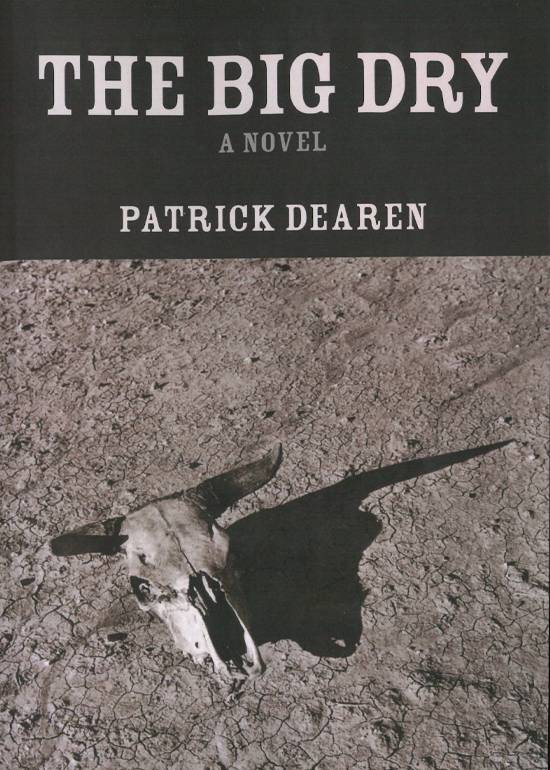
The Big Dry
by Patrick Dearen
Fort Worth, Texas: TCU Press, 2024.
204 pp. $24.95 Paperback.
Reviewed by
Burke De Boer
“While its plot feels like classic investigative western-suspense, what elevates The Big Dry out of a position on feed store spinner racks is how Dearen uses this set-up to explore environmental and racial issues in Texas in 1886.”
One of the core values of the western genre, both in story and song, is the referencing of hardtack specifics. However fictional a story’s machinations, its aesthetic pieces are often drawn from true ways of being, true bits of history. This might come down to a belief that, as Drum Hadley wrote in Voice of the Borderlands, “we are created in the image of the Earth, and we become what surrounds us.”
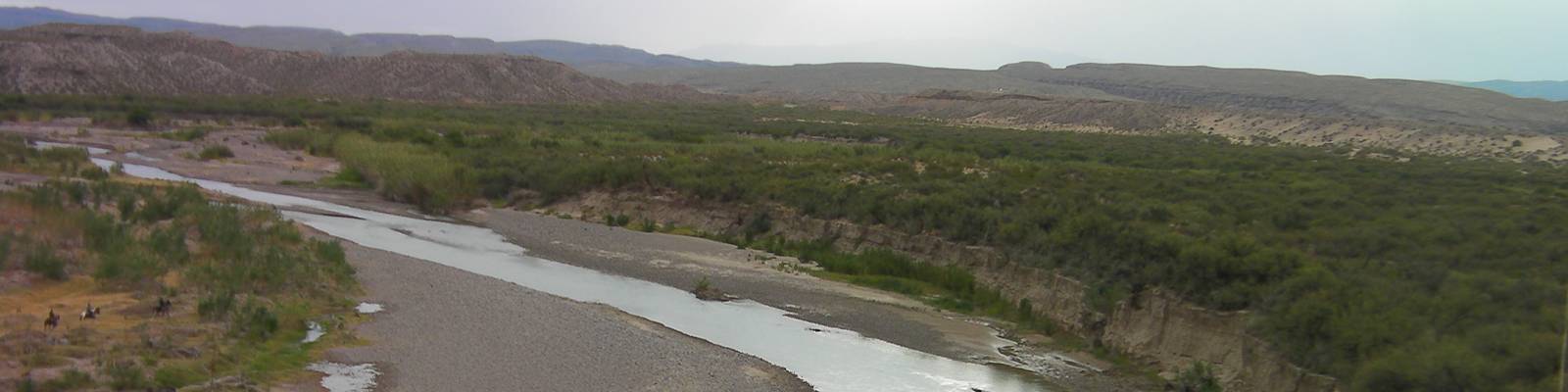
Patrick Dearen, as a historian and folklorist, has a great depth of knowledge for the hardtack specifics of the Pecos and Devils River area. He takes us there in The Big Dry, a novel set in the West Texas drought of 1885-1887. His prose and characters are surrounded and constricted by the harsh landscape and draconian laws of this specific place and time. In the parting words of the author’s note, Dearen quotes a cowhand of the era saying this drought “broke all the little cowmen on the Pecos.” He takes us to the breaking point in this novel, which masterfully blends cowpuncher anthropology with classic genre suspense.
Protagonist Will Brite sets out from North Texas to Southwest Texas, hiring onto a cattle drive on which he’s tracked the cowboy responsible for a murder currently pinned on his friend. The man the law’s accused is Zeke Boles, a Black cowhand. Further centering race relations of the era, Will is married to Jessie, a mixed-race woman.
The world Will Brite plunges into is a hostile one, full of cattle dead on the trail and bloating in the sun, and populated by a variety of racist villains. As a hero, Will struggles with his own internalized views shaped by the same culture and law of the villains. But the read is, surprisingly, not off-putting. Dearen’s prose is lyrical, beautiful, and highly compelling. Rarely does a page pass without an absolute painting of a sentence, something evocative crafted in a flowing meter, such as “Will had little to say as they bore into the sunburst to the rhythmic beat of hooves.”
There is a great balance throughout the narrative. While there are plenty of harsh and sharp-edged plot beats, like looking for a gun and a money belt hidden in the carcass of a dead cow (which feels like the graveyard treasure hunt from The Good, the Bad, and the Ugly, only far more disgusting), there are also soft and gentle moments, such as when Will leaves Jessie’s side in the morning he sets off for the Pecos country. This moment puts more of Dearen’s lyrical finery on display: “Never had the singing of crickets been this lonely, or the dawn broken so gray.”
While its plot feels like classic investigative western-suspense, what elevates The Big Dry out of a position on feed store spinner racks is how Dearen uses this set-up to explore environmental and racial issues in Texas in 1886. There is an awareness that speaks to similar issues of today.
While the story entertains, the real reason to read this novel is in the specific insights Dearen imparts as he delves into one of the worst droughts of Texas history, and it leaves readers considering the cultures and catastrophes that the Lone Star State has inherited.
Dialogue written with dialect can grate some readers’ ears. If you fall into this camp, be forewarned that Dearen uses the technique. This is an extension of the specificity of place that western writing demands. To modern sensibilities, the dialogue of the Black characters can take on an unfortunately minstrel affect; meanwhile England-educated character Arch Bannon’s highfalutin speech contrasts the southern cowhands’ colloquial gruntings in such an extreme way it sometimes also feels vaudevillian. If you can lean into this dialogue, however, you may feel even more immersed in the rhythms and habits of a place as it was.
The book is billed as a “standalone sequel” to The Big Drift. Having not read the predecessor, The Big Dry works fine on its own. Dearen gives us all needed context about motivations and relationships along the way by taking us back to moments in Wyoming. This helps both the narrative and the environmental tone. While I can’t speak to how much ground is being retread in the flashbacks, I believe Dearen is a master of the elements, using the juxtaposition of the big Wyoming blizzard of the first book to emphasize the scorching Texas drought. The Big Dry succeeds as a place-and-climate-focused shoot-’em-up, something that any fan of Zane Grey or Larry McMurtry would enjoy.
Burke De Boer is a viticulturist in the Texas Hill Country AVA and an MFA candidate in Creative Writing at Texas State University. Before this, he was a rosin jaw in Central Oregon, a tree planter in Western Oregon, and inducted into the Xi Sigma Pi Honor Society of Forestry at Oregon State. His essay collection Songs of the Cyberspace Cattle Drive is forthcoming from Cowboy Jamboree Press.