


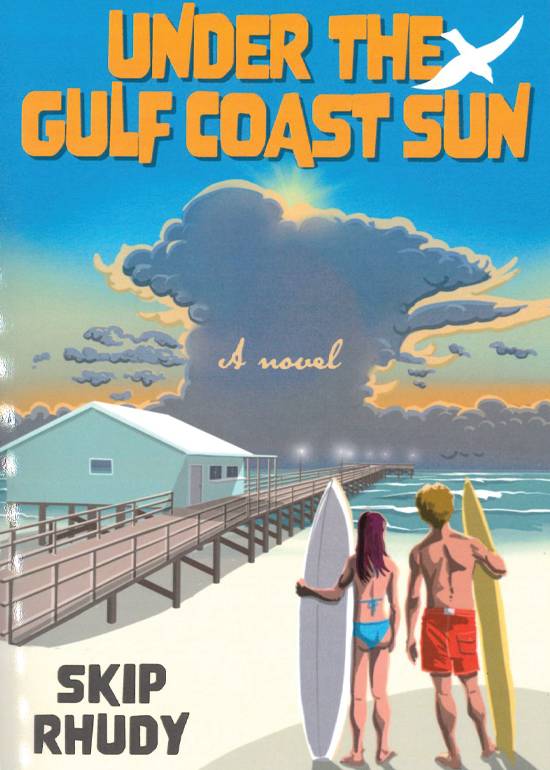
Under the Gulf Coast Sun
by Skip Rhudy
Wimberley, Texas: Stoney Creek Publishing, 2025.
258 pp. $22.95 Paperback.
Reviewed by
Julia Hammond
“Imagine packing for a vacation and searching for the right beach read—a fast-paced, immersive novel to whisk you away.”
Imagine packing for a vacation and searching for the right beach read—a fast-paced, immersive novel to whisk you away. With escapist charm, Under the Gulf Coast Sun centers on a summer romance between Connor and Kassie, two high school graduates figuring out how to spend their summer. Kassie, a frequent tourist, returns once more to Connor’s coastal hometown, but this summer is different. It might be their last chance to admit their feelings. Amid complicated decisions, the drama of a small coastal town, and a freak accident at sea, Skip Rhudy’s Under the Gulf Coast Sun delivers a story rooted in the surf culture of the 1970s and the inevitable obstacles of growing up.
Set on the shores of Port Aransas, Texas, the novel captures the surfing culture of the Gulf Coast in a way that’s unexpectedly engaging and immersive. Rhudy clearly knows the Port Aransas atmosphere and the aesthetics of a coastal town, giving the book a grounded sense of place. The setting functions as a metaphorical framework, tying together the rhythm of the waves to the ebb and flow of sexual desire and young love—one of the book’s sharper creative aspects. The pull of the ocean, the danger and thrill of surfing, and the taste of saltwater all shape how readers experience the novel. In these moments, Under the Gulf Coast Sun feels most alive.
The exhilaration of a summer fling crashes down when Kassie earns a full ride scholarship to UC San Diego’s space program. She dreams of working at NASA, following in the footsteps of her father, but this opportunity complicates her budding relationship with Connor. Will she choose to stay with Connor in Port Aransas or take the opportunity of her dreams? While an interesting conflict indeed, it’s an overused, false binary that feels reductive. Considering this book is set in the 1970s, the gender dynamics may reflect what women choosing college and careers at the time were facing. There were opportunities to complicate Kassie’s decision, to show that academic ambition and love might productively coexist, but instead Rhudy narrows her struggle into a cliché. In a decade when women were entering universities in greater numbers and feminist thought was gaining interest, Kassie could have embodied the struggles of her generation. There could have been a more nuanced treatment showing her negotiating conflicting pressures without reducing her life to a ‘love versus school’ ultimatum. By flattening her dilemma, Rhudy unintentionally undercuts her character and the history he wants to evoke.
While the central conflict between Connor and Kassie keeps the audience rooting for their relationship’s success, the execution of their romance falters at times. Rhudy successfully captures the uncertainty of young love, and his depiction of sexual desire is attractive, but he often interrupts the mood with clumsy lines that sound more like locker-room banter. This comedic and unserious language spoils what could have been meaningful erotic scenes, taking readers out of the once-immersive story. While this narrative style might try mirroring an authentic frustration with sexual desire, it too often comes across as more awkward than arousing.
Unfortunately, Rhudy’s careless handling of intimacy leads to questionable interactions between Kassie and other male characters. Practically every male character (aside from Connor) crosses the line from “flirting” into blatant harassment, which the narrative brushes aside. Stamford’s behavior toward Kassie is a prime example. He is one of Connor’s friends, but not only does he try to take his chances at sleeping with Kassie, he insults her when he doesn’t get what he wants. Stamford is incapable of reading the room when Kassie—or anyone for that matter—is uncomfortable. The problem is not just that these interactions happen, but that they are never meaningfully challenged.
Rhudy’s failure to create meaningful interactions between characters is a direct result of inconsistent character development. Connor, for instance, goes from being a nervous wreck to suddenly pulling off a smooth confidence in front of Kassie at a party with no clear transition—an inconsistency that is ignored to keep the story moving. Connor’s so-called “friends,” like Stamford, Robinson, Franklin, and Maxim, only add to this frustration. While Stamford in particular comes through in a time of crisis towards the end of the book, this does not change his pestering presence. Connor’s friends are all irresponsible partygoers and verbally abusive: all around unlikeable characters that get in the way of the romance plot with Kassie. It is unclear why Connor would hang around them at all. Moreover, Connor’s sensitive and thoughtful demeanor, meant to set him apart from his friends, is undermined by sudden bursts of arrogance that feel out of place. One could argue that Rhudy is gesturing toward a contrast between different models of manhood, but the lack of development keeps this from fully resonating. Instead of interrogating the culture that enables these young men, the novel shrugs it off as normalized background noise.
Despite these shortcomings, Under the Gulf Coast Sun may still appeal to readers seeking a classic summer novel. Surfers or those familiar with the Gulf Coast might find joy in the sensory details of Port Aransas. Readers craving the nostalgia of the 1970s coastal youth might also forgive the thin characterizations in favor of reliving a certain cultural moment. Rhudy shows he can capture the atmosphere of a time and place, but atmosphere alone cannot carry a story weighed down by clichés and underdeveloped characters. Readers may leave the book entertained in fragments, but also wishing for a narrative as powerful and unpredictable as the waves Rhudy so lovingly describes.
Julia Hammond is a graduate student at Texas State University working towards her Master of Arts in Literature. She graduated with a B.A. in English from Florida Gulf Coast University in 2022, and she continues to write across various genres.